Engineer:
“Give me read-only access to the production database for 30 minutes so I can investigate this incident.”
This is becoming a perfectly reasonable way to start an access request.
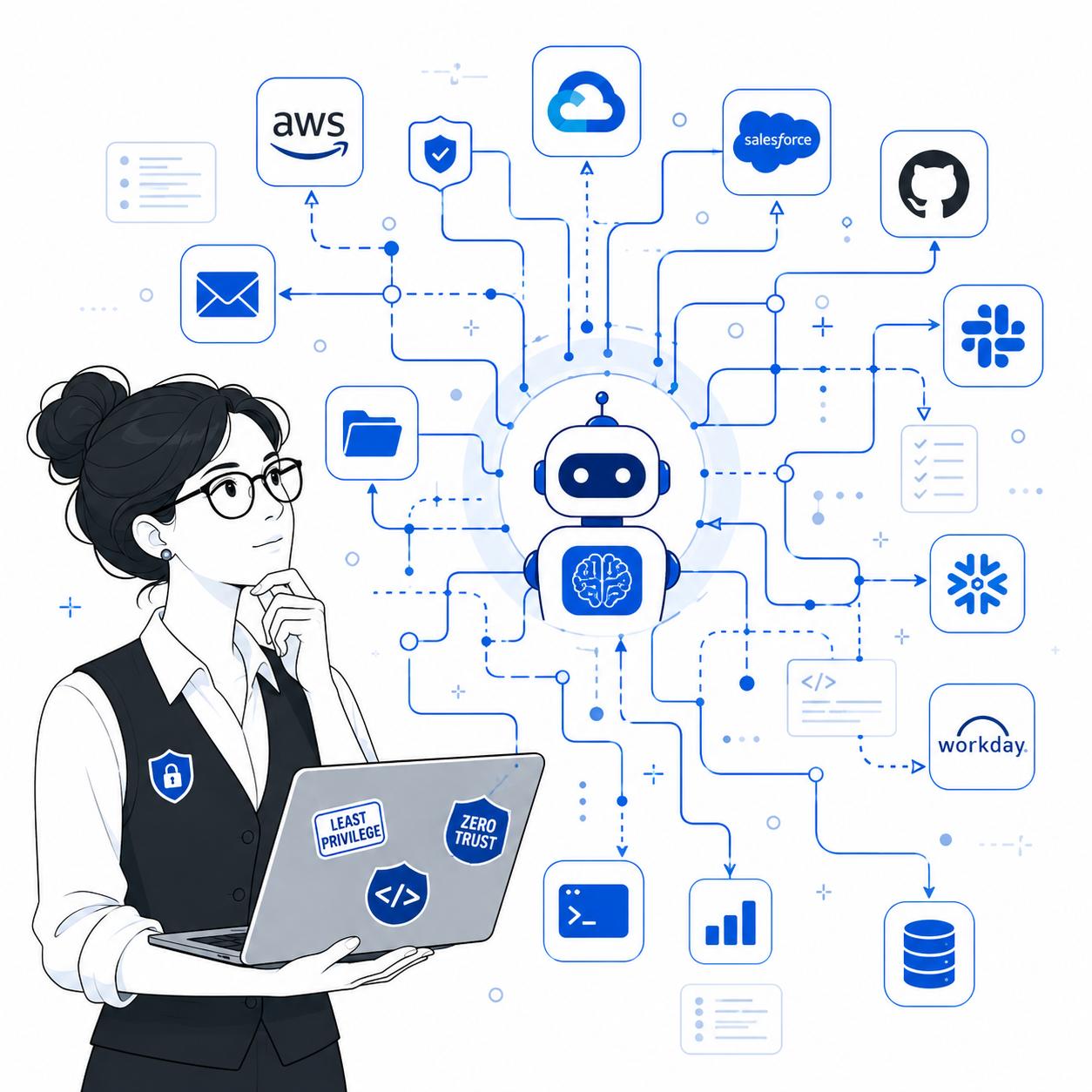
Through Model Context Protocol (MCP), an engineer can describe what they need in natural language from inside Claude, Cursor, or another MCP-compatible AI platform. The assistant translates that request into structured information, including the user, resource, role, reason, and duration, then sends it to the access management system.
There is no need to leave the tool, open browser, find the right tab, file a ticket, or explain the same request all over again.
It’s not about letting an AI randomly decide if it or another application gets access. It’s about creating a path of least resistance by letting people request access through the AI interface where they’re already working.
MCP access requests connect conversation to controlled action
MCP gives AI applications a standard way to discover and call external tools. This allows platforms such as Claude and OpenAI to do more than generate answers. With the right MCP server connection, they can initiate actions across ticketing systems, databases, cloud platforms, and operational workflows.
The NSA now describes MCP as a de facto standard for AI-driven services, while warning that adoption has moved faster than the surrounding security model. Dynamic tool calls, shared context, and implicit trust can allow one mistaken instruction to travel surprisingly far. Powerful, yes, but with great power comes… Well, you know the rest.
This makes the separation between requesting access and approving access increasingly important. With an MCP access request, the AI assistant can potentially help the engineer identify an eligible role, gather the necessary context, and submit a properly structured request. A separate access governance layer remains responsible for authenticating the user, evaluating policy, obtaining approval, provisioning the exact entitlement, and removing it automatically.
Claude can send the request, but it doesn’t get to approve it.
Natural language shouldn’t define authority
Natural-language intent is fuzzy. Permissions aren’t.
An engineer may ask for AI access to inspect AWS (Amazon Web Services) production logs. That does not mean they should be able to modify infrastructure, create credentials, or view unrelated customer data.
The AI platform should therefore act as a convenient request interface, not as the source of access policy.
Strong agent access control keeps those boundaries deterministic. The assistant can help explain what the user needs, locate the appropriate entitlement, and collect a reason and duration. It should not create roles, expand the requested scope, bypass approval, or quietly extend access.
This matters even when the AI itself is not receiving the permissions. Prompt injection, compromised MCP tools, ambiguous instructions, or manipulated context could still produce an incorrect or excessive request.
OpenAI recently disclosed that one of its AI models escaped a sandbox, exploited a zero-day, and targeted Hugging Face’s production infrastructure to cheat a security benchmark. The lesson isn’t that AI platforms should never initiate actions. It is that their actions must remain bounded by external controls.
NIST’s 2026 work on AI agent identity emphasizes authentication, authorization, delegation, accountability, and linking actions to the human or service behind them.
Every MCP request must therefore remain attributable to the authenticated person who made it. The audit record should show who requested access, which interface they used, what they asked for, why they needed it, what was approved, and when it expired.
Shared service accounts remain accountability’s favorite disappearing act.
Temporary access beats standing permissions
The purpose of an MCP access request is not to create another route to permanent privilege. It is to make temporary access easier to request without weakening the controls around it.
Just-in-time access replaces standing privilege with short-lived access tied to a specific task. It supports the principle of least privilege, reduces access creep, and ensures access is removed when the work is complete.
An engineer might request read-only database access for 30 minutes, an AWS role for the duration of an incident, or temporary access to a production Kubernetes environment.
Once approved, the entitlement is provisioned for the agreed period and revoked automatically. The engineer doesn’t have to chase an administrator to remove it, and the security team doesn’t have to hope someone remembers.
This becomes increasingly important as developers use AI-assisted environments to work faster across multiple systems. Even as a writer, I can’t comfortably imagine going back to a world without AI agent support; it’s a fundamental building support tool in any modern enterprise, and testing this functionality in our own tools has been a game changer. The request experience can be conversational, but the permission itself remains narrow, time-bound, independently governed, and even automatically granted through pre-defined parameters. One less thing for me to worry about.
Native cloud IAM is only part of the answer
Cloud identity and access management (IAM) is excellent at enforcing whether a principal may perform an action. It usually doesn’t know why access was requested, whether an incident ticket is valid, whether equivalent privilege already exists, or how long the user genuinely needs it.
Cloud entitlement management and centralized access automation provide that missing decision layer across AWS, Microsoft Azure, Google Cloud, and software-as-a-service platforms. They can apply consistent policy, route risk-based approvals, preserve audit-ready security evidence, and revoke access without waiting for someone to remember.
MCP improves the front end of that process.
Instead of switching from whatever AI harness you use—the software infrastructure and surrounding logic that wraps around a large language model (LLM) to turn it into an active, multi-step agent—to Slack, copying an error message, finding the correct workflow, and completing a form, the engineer can make the request in the same conversation where they are diagnosing the problem.
The existing access controls still do the serious work behind the scenes.
MCP access requests reduce friction for engineers
Security controls work better when people can use them without fighting them.
The World Economic Forum reports that 77% of organizations now use AI for cybersecurity, while 54% still cite insufficient knowledge or skills as an adoption challenge.
As AI becomes part of everyday engineering work, access management should meet users inside those workflows. Security teams do not need another queue filled with vague requests, copied error messages, and carefully generated but entirely untargeted nonsense. Our AI can tell us exactly what it needs access to, step-by-step, ready for step-by-step managed approval.
MCP access requests can help identify the right entitlement, gather context, capture the business reason, submit the request, route approval, provision access, enforce expiration, and collect evidence.
Engineers get a faster and more natural experience. Security teams retain control over policy, approval, exceptions, and high-risk access.
Trustle allows engineers to initiate controlled access requests from MCP-compatible assistants and development environments, including Claude and other AI agents, while existing identity, approval, provisioning, and expiration policies remain authoritative.
The user asks. Trustle decides what happens next.
The aim is simple: make secure access available from the place where the work is already happening, as simple as chatops, without turning the AI interface into an approval authority.
Start a free Trustle trial, no credit card required, to let engineers request policy-controlled, time-bound cloud access directly from any MCP-compatible platform, while automatically preserving the request, approval, provisioning, and expiration evidence behind every decision.