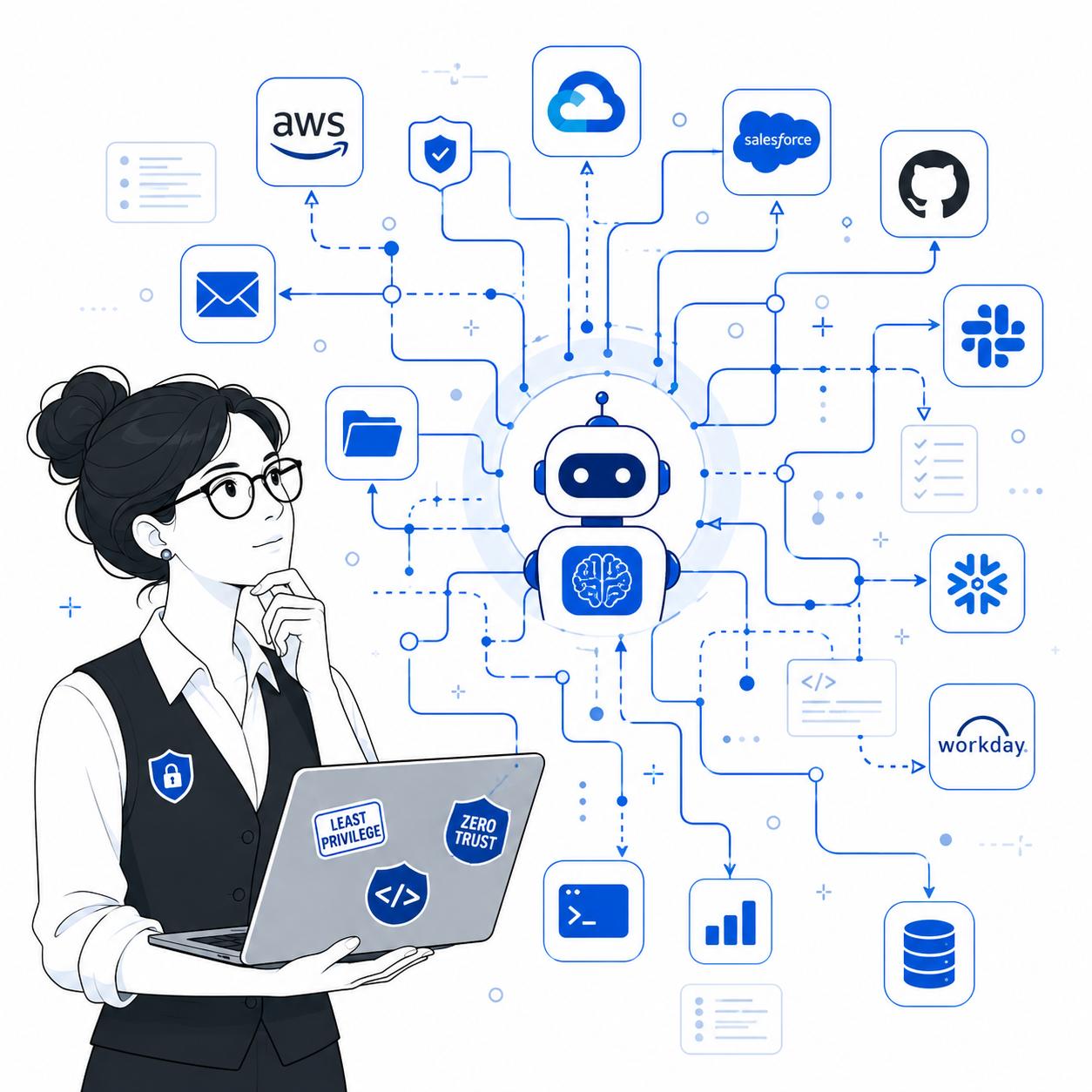
Somewhere in your organization right now, an AI agent is being asked to “just help out a bit.” Summarize tickets. Triage alerts. Spin up a test environment. Maybe, just maybe, push a config change to production “if it looks safe.” And that’s the moment your future auditor starts sharpening their pencil and making a sucking noise through their teeth.
Agentic AI is crossing a line from assistive to decisive: systems that can plan, choose tools, and execute actions across cloud, SaaS, and internal platforms. Security teams can love the speed and still hate the risk. In fact, a recent report [TechRadar] found 71% of companies are using AI agents, but only 11% of use cases reached production in the past year, largely due to trust, transparency, and regulatory concerns. That needs to be fixed for the future, and to stay competitive.
In 2026, auditors won’t be asking whether you’re “doing AI.” They’ll ask something far more problematic and far more relevant, and this will be a critical part of future international cybersecurity standards:
Which identities do your AI agents use, what can they do, and can you prove those controls work over time?
In 2026, “AI Governance” Becomes Audit Reality
If you operate in Europe (or sell into it), the EU AI Act alone is enough to move this from “nice-to-have” to “show-me.” The Act entered into force on 1 August 2024, with phased obligations: prohibited practices and AI literacy from 2 February 2025, governance rules and obligations for general-purpose AI models from 2 August 2025, and the Act will be fully applicable from 2 August 2026 (with some longer transitions for specific high-risk categories).
Even if your agents aren’t “high-risk AI systems” under the Act, the audit mindset will still shift: you are deploying autonomous decision-and-action systems, and you need governance, accountability, and evidence. This is the way.
Now, stack on the rest of the 2026 pressure cooker:
- NIS2 pushes organizations toward demonstrable cyber risk-management measures across critical sectors, and the EU’s own summary frames it as a unified legal framework to uphold cybersecurity.
- ENISA’s technical implementation guidance (written to help with NIS2-style measures) explicitly calls out privileged access control and monitoring, including granting and revoking privileged access rights, and even gives examples of evidence an assessor would expect to see.
- If you’re in financial services (or supply it), DORA applies from 17 January 2025, and it has the same appetite for controls that are provable, not anecdotal.
- If you build and ship products with digital components, the EU Cyber Resilience Act introduces reporting obligations from 11 September 2026 for actively exploited vulnerabilities and severe incidents. Yet another reason auditors will care about what’s running, what it touches, and how quickly you can respond.
Translation: In 2026, “we have some AI agents” has become “we have a new class of operational actor inside our control plane.” And auditors love nothing more than a new class of operational actor.
The Auditor’s Mental Model: AI Agents Are Privileged Identities
Here’s the blunt truth: auditors don’t care whether your agent uses an LLM, a planner, or a hamster in a wheel fed on Espresso and complimentary pizza. They care whether it can do things.
If an agent can deploy, change IAM, read sensitive data, export data, rotate secrets, or disable controls, it is effectively a privileged identity. Which drops it straight into familiar control expectations:
- Access control rules exist, are enforced, and are reviewed (think ISO 27001-style access controls).
- Privileged access is tightly governed (authorized, limited, monitored).
- Logging exists and supports investigations and accountability.
- AI governance is managed across the lifecycle, not improvised in production (ISO/IEC 42001 is literally an AI management system standard).
- AI risks are managed in a structured way (NIST AI RMF organizes activities into Govern, Map, Measure, Manage).
And then there are the AI-specific problems auditors are learning to recognize, especially prompt injection. OWASP ranks prompt injection as a top risk for LLM applications. The UK’s NCSC has also warned that prompt injection may never be fully “solved” in the way we solved earlier web vulnerabilities, which pushes organizations toward compensating controls that limit impact.
That lands you right back at identity and access control: if you assume agents can be confused or manipulated, you must reduce what they can do by default, and tightly govern elevation.
The Questions You Should Expect (and how to answer them without sweating)
Auditors will keep it simple. Expect versions of:
1) “What agents do you have, and what do they touch?”
Have an agent register: owner, purpose, environment, systems/data accessed, and a risk tier (read-only, change-making, or privileged).
2) “What identity do they use?”
Each agent should have a distinct identity (not shared accounts), with clear authentication, credential hygiene, and no long-lived “forever tokens” or breakglass, if you can possibly help it.
3) “How do you stop standing privilege?”
This is where a modern platform like Trustle comes in. Use just-in-time, time-boxed access for privileged actions, with tight scopes and automatic revocation. If an agent only needs elevated access for 10 minutes to complete a bounded job, give it 10 minutes, not a permanent role “for convenience.”
4) “Show me the evidence.”
Auditors want artifacts: request/approval logs, access grants, expiry, revocation, and activity. The gold standard is access receipts, a defensible record of who/what received which access, when, why, for how long, and what they did with it.
5) “What about prompt injection and tool misuse?”
You won’t “patch” your way out of this. You reduce impact: constrain tools, limit privileges, gate high-risk actions, monitor for abnormal behavior, and keep the ability to cut access instantly.
Why This Isn’t Just Audit Theatre
Data exposure is already surging around AI use. Netskope reports organizations average 223 genAI-related data policy violations per month, with the top quartile seeing 2,100 incidents per month, a statistical reminder that AI adoption tends to arrive before governance does.
Agentic AI adds a further twist: not only can it leak data, but it can also act on it.
So our 2026 goal is straightforward: keep automation, add control.
- Default agents to least privilege
- Elevate only when needed (just-in-time access)
- Scope tightly, expire quickly
- Continuously detect and remove excess privilege
- Log everything and produce audit-grade evidence
You can get started in about 30 minutes. Our free trial turns assumptions into evidence, ad-hoc AI approvals into policy, and regulates enforcement across multi-cloud security. Do that, and when your auditor asks about AI agents in 2026, you won’t be stuck saying the four most expensive words in security: “Honestly… I’m not sure.”