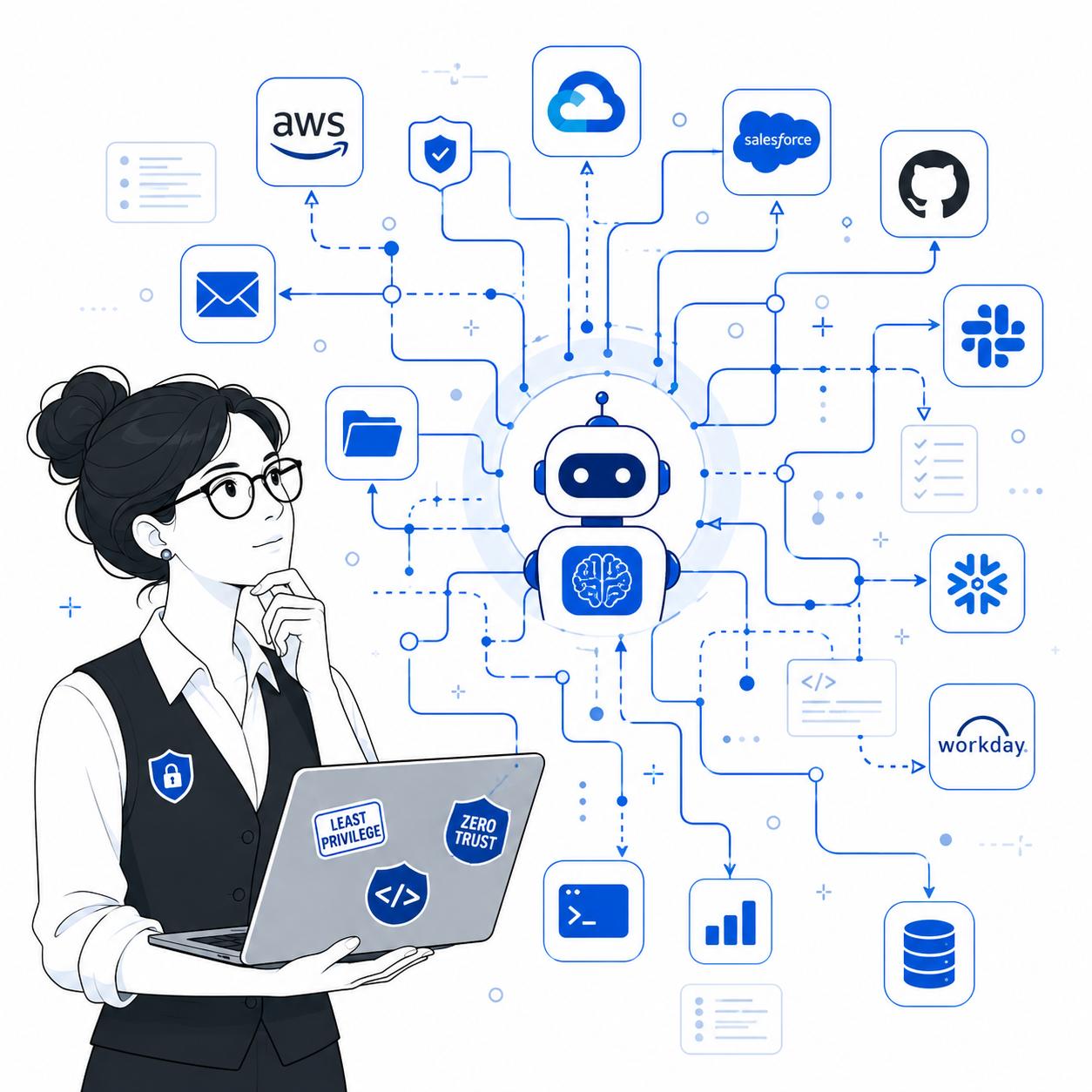
If you’ve ever watched an “autonomous” agent happily chain together ten actions across your cloud estate, you’ll recognize the feeling: part wonder, part dread. It’s like hiring a super-efficient intern who never sleeps… and then realizing you’ve also given them the building master key, a pint of espresso, the alarm code, and a forklift licence.
That tension is exactly why agentic AI is hitting turbulence in the real world. TechRadar found 71% of organizations say they use AI agents, but only 11% have actually pushed agentic use cases into production, with trust and risk concerns as major blockers.
Security teams aren’t being awkward. They’re being realistic: autonomy + broad access + machine speed is how small mistakes become “all-hands incident call”.
However, we can secure agentic AI without strangling automation: treat agents like privileged identities, make access temporary and tightly scoped, and generate audit-grade evidence by default. In other words: keep the speed, lose the chaos.
Step 1: Admit what an AI agent really is: a privileged identity
Most agents don’t “just think”. They do. They call APIs, read data, create resources, rotate configs, open tickets, approve workflows, and deploy code. To pull that off, they need credentials, permissions, and paths into your systems.
Agentic AI are non-human identities operating inside your control plane.
Identity security vendors have been blunt about this: treat AI agents like privileged machine identities and extend proven controls (least privilege, monitoring, strong governance) to them.
If you do nothing else, do this: give each agent a distinct identity (no shared service accounts), and model it like you would a high-impact admin user or automation pipeline.
Step 2: Kill standing access (for agents) before it kills the business
Standing privileges are already a bad idea for humans. For autonomous agents, they’re a liability with an IV coffee drip.
Why? Because agentic systems don’t just “have permissions”. They exercise them constantly, at speed, and often across multiple systems. If an agent is compromised (or simply tricked), the blast radius is whatever you pre-authorized… forever.
This is where zero standing privilege thinking becomes the difference between automation and automated disaster.
What “safe speed” looks like in practice:
- Just-in-time access elevation: access is granted only when a task begins
- Tight scope: permissions limited to the specific action set (not “admin, because reasons”)
- Automatic revocation: access expires the moment the job is done (or the clock runs out)
- Approvals when needed: high-risk steps can require a human or policy gate, without blocking everything
This is exactly the sort of workflow an access platform can enforce: request → policy evaluation → optional approval → time-boxed credentials → auto-revoke → full record of why it happened.
Step 3: Reduce the “agent sprawl” you can’t currently see
Most organizations don’t have “an agent”. They have an incident helper agent, a data summarizer agent, a ticket triage agent, a CI/CD release agent, a cloud cost optimizer agent, plus experimental agents that never got deleted (because of course).
The security problem isn’t just permissions. Its visibility: what exists, what it can touch, what it is actually used for, and what it still has.
This matters because AI is already amplifying data exposure risk. Netskope Threat Labs reports organizations average 223 genAI-related data policy violations per month involving sensitive data, and the worst-affected quartile sees far higher volumes.
If employees are leaking sensitive info into AI tools at that rate, imagine what happens when autonomous agents have broad read access to data stores and the ability to move it around.
A strong control here is continuous entitlement discovery and over-privilege detection for both human and non-human identities:
- What permissions does this agent have in AWS/Azure/GCP/SaaS?
- Which are unused and should be removed?
- Where is privilege accumulating over time?
- Which keys/tokens are unrotated or long-lived?
- Which paths allow lateral movement?
Done right, this doesn’t slow teams down. It stops yesterday’s “temporary exception” from becoming tomorrow’s breach path.
Step 4: Put guardrails on actions, not just log files
Classic monitoring gives you a crime scene photo. Agentic AI needs something closer to runtime governance:
- Detect unusual action sequences (“why is the agent enumerating IAM roles at 2am?”)
- Detect unusual targets (“why is it touching finance buckets?”)
- Detect unusual privilege requests (“why does it need tenant-wide admin?”)
- Apply policy-based controls and break-glass behavior when risk spikes
McKinsey makes the same core point from a governance angle: agentic AI can turn risk into a “black box” unless you assess risks per use case and build transparency into how agents operate.
Security teams don’t need perfect explainability. They need enough explainability to answer: who/what did what, using which access, for what reason, and under which controls?
That’s the real prize: access receipts.
Step 5: Use a “tiered autonomy” model so you don’t smother the good work
Here’s the compromise that keeps everyone sane:
Let low-risk tasks run fast. Gate high-risk tasks intelligently.
A practical model:
- Tier 0 (Read-only (and read-restricted)): summarize, report, query metrics
- Tier 1 (Low-risk write): create tickets, open PRs, tag resources
- Tier 2 (Controlled change): deploy to staging, rotate a secret, quarantine an endpoint (policy + JIT)
- Tier 3 (High impact): production changes, IAM role edits, data export (approval + tight window + strong evidence)
This is where an access-control platform earns its keep: it can implement tiers as policy, automate approvals, issue time-bound credentials, and keep an audit trail you can hand to an assessor without breaking into a sweat.
Best Existing Instincts
Agentic AI doesn’t require a brand-new security religion. It requires you to apply your best existing instincts — least privilege, time-bound access, continuous review, and audit-grade evidence — to a new kind of actor that moves faster than your old controls were designed for.
Keep automation. Lose standing privilege. Give agents capabilities on a leash.
Because “autonomous” is great for productivity. It’s less great as an incident root cause category.